In leadership, delay can feel responsible. It can look like prudence, careful analysis, or simply giving a complex issue more time. But in reality, waiting too long on leadership decisions often creates hidden risks that quietly compound until they become much harder — and more expensive — to solve. In food and agriculture, where margin pressure, weather volatility, labor constraints, supply chain disruption, and regulatory scrutiny all collide, indecision can do real damage.
Senior leaders rarely lose ground because they made one dramatic bad call. More often, they lose momentum because they let too many important choices sit too long. That is why decision-making in leadership is not just a management skill; it is a strategic advantage. When decisions stall, teams begin filling the gap with assumptions, and organizations start operating without a clear direction. Over time, that ambiguity can become more costly than the original decision itself.
There is a reason delayed decisions are so common at the top. Leaders are trained to reduce risk, weigh tradeoffs, and avoid unnecessary mistakes. In complex organizations, especially in agriculture and food systems, many choices have downstream effects across operations, procurement, customer relationships, and brand reputation. So leaders wait for more data, more alignment, or more certainty.
The problem is that uncertainty rarely disappears. Instead, it grows while the decision sits. Commentary on the cost of indecision in leadership from Clarity Market Research explains how hesitation quietly erodes momentum, trust, and leverage. In other words, the decision does not stay neutral just because it has not been made yet. In fast-moving environments, delay itself becomes a choice with consequences.
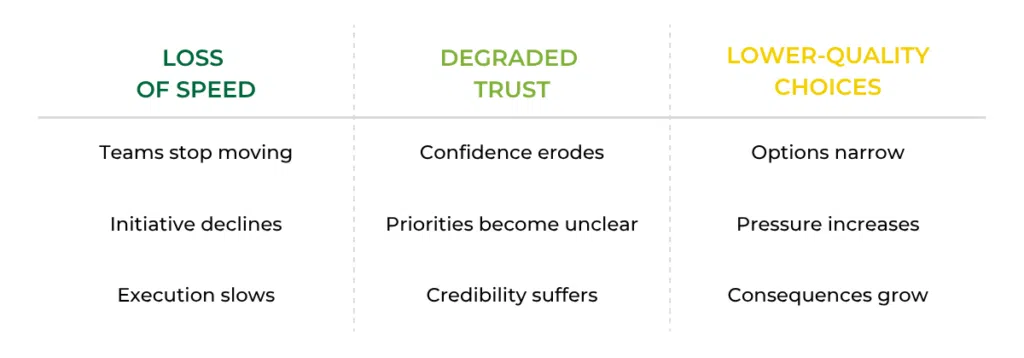
The first hidden risk is loss of speed. When leaders hesitate, teams slow down too. People stop planning, stop escalating, and stop taking initiative because they are waiting for direction. That can create a culture where everyone holds back until the leader moves first, which is especially dangerous in organizations that need quick execution across seasons, markets, or production cycles.
The second risk is degraded trust. Employees notice when key issues linger. If people cannot tell whether a decision is actually coming, they begin to question priorities and leadership confidence. Over time, that uncertainty can weaken credibility more than a difficult but timely decision would. Strong strategic decision making requires not only good judgment, but also enough clarity for others to act with confidence.
The third risk is lower-quality choices later. Waiting often feels like protecting the organization from error, but in many cases it simply compresses the timeline for action. That means leaders eventually decide under more pressure, with fewer options and greater consequences. A delayed call can turn a manageable issue into a crisis, especially when it affects supply, labor, customer service, or operational readiness.
Food and agriculture leaders operate in a particularly unforgiving environment. Weather windows close fast, markets shift quickly, and labor or supply issues can escalate without warning. In that setting, leaders do not have the luxury of sitting on important decisions for too long.
That is why executive leadership in food and agriculture depends on both sound judgment and the ability to move with pace. Preparing leaders for enterprise responsibility takes more than technical know-how; it also takes the confidence to make timely calls when the stakes are high. Waiting too long can narrow the organization’s options and mean missing the best window to act.
The goal is not to make reckless decisions faster. The goal is to decide at the right speed for the issue at hand. Strong leaders separate reversible decisions from irreversible ones, then adjust the process accordingly. They also define who decides, what input is needed, and by when. That keeps the organization from confusing discussion with progress.
Another important habit is creating psychological safety. When teams know they can raise concerns without penalty, leaders get better information sooner. Research on psychological safety in the workplace from Harvard shows that people are more willing to speak up, share ideas, and surface risks when they feel safe contributing honestly. In practice, that means better decisions, earlier warnings, and fewer unpleasant surprises.
Leaders also need a bias toward closure. Not every decision needs perfect certainty. Many only need enough information to move forward responsibly. Once the path is chosen, the job shifts from overthinking to execution, learning, and adjustment.
A useful rule for senior leaders is to ask three questions:
Those questions help distinguish careful leadership from avoidable delay. They also reinforce an important truth: people do not just judge leaders by the decisions they make. They also judge them by the decisions they postpone.
In food and agriculture, the hidden risk of waiting too long is not just missed timing. It is missed trust, missed momentum, and missed opportunity. The strongest leaders know that some decisions improve with reflection — but many deteriorate with delay.
***
If your organization is wrestling with decision bottlenecks, the real question may not be whether you have enough information. It may be whether the cost of waiting has already become the bigger risk. We welcome connecting with you to discuss how to strengthen decision-making, reduce delay, and move the right issues forward with more confidence.
Kincannon & Reed incorporates validated interview techniques and evaluation tools to accurately assess candidates. We have the capability to measure personality traits, motivations and evaluate specific competencies and behaviors. The right assessments provide a balanced approach to understanding potential as much as experience.
Coaching empowers executives to reach their full potential faster, benefiting your organization. We partner certified coaches with executives and use a strengths-based approach to guide leaders through a process that maximizes their potential to drive success.
We bring a history of success delivering advisory and fiduciary board members specifically for family, start-up, and growth organizations. Our industry networks and broad access to executive leadership bring willing candidates from every corner of the market to serve on your board.