In today’s highly competitive market for executive talent, attracting the right leaders requires more than a compelling role or competitive compensation. The most sought-after executives are conducting their own rigorous due diligence, well before they formally engage in a search process or consider an offer.
While organizations often focus on evaluating candidates’ experience, leadership capabilities, and cultural fit, top executives are equally focused on assessing the organization itself. They are asking a fundamental question: Is this an environment where I can succeed—and is it worth the move?
For boards, CEOs, and leadership teams across the food and agriculture sector, understanding how executive candidates evaluate opportunities is critical to consistently attracting high-impact leaders.
Exceptional leaders are drawn to high-performing leadership teams, and they can quickly identify when something is off.
During the recruitment process, candidates closely observe how leaders interact, make decisions, and align around priorities. They are assessing whether the leadership team operates with clarity, cohesion, and trust.
Key questions often include:
Research from McKinsey highlights that organizations with aligned and cohesive leadership teams are significantly more likely to outperform peers, particularly during periods of volatility
Even the most attractive role can quickly lose momentum if candidates sense dysfunction or misalignment.
Top candidates are not just evaluating the role; they are evaluating the trajectory of the business.
They want to see a clearly articulated vision supported by a credible path forward. In food and agriculture, where volatility, innovation, and supply chain complexity are constant, strategic clarity becomes even more important. Leaders are assessing whether the organization understands where it is going, how it will get there, and whether the leadership team is aligned around that path.
Strategic ambiguity is one of the fastest ways to lose strong candidates, particularly those leaving stable, successful roles where direction and priorities are already well established.
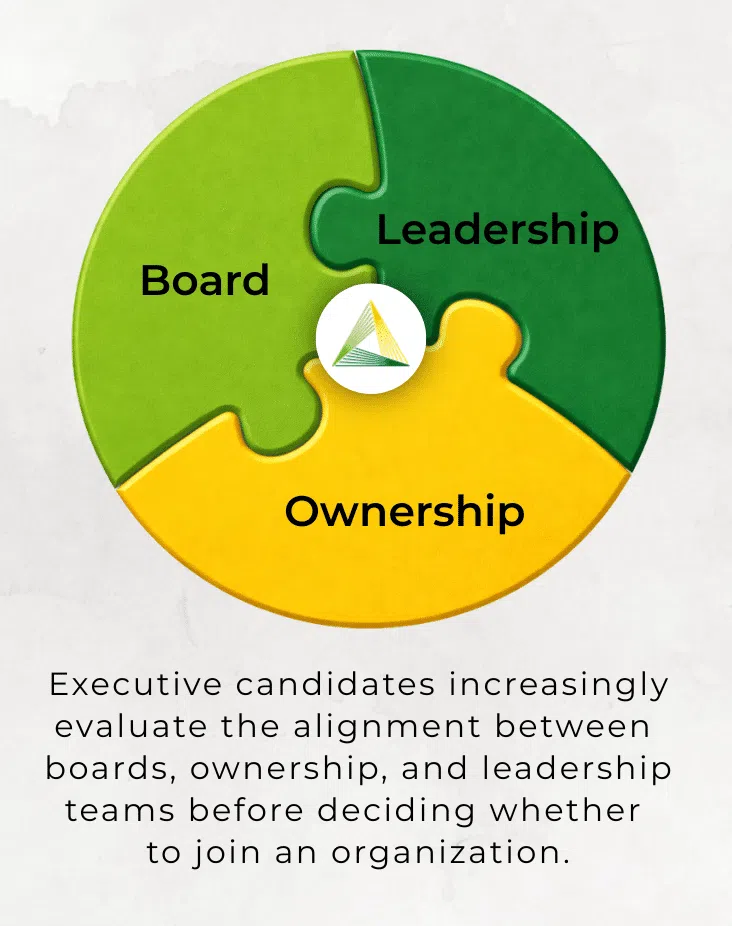
For senior leaders, governance dynamics are central to the decision—not a secondary consideration.
Candidates increasingly seek transparency into how boards and ownership groups operate, including expectations, decision rights, and investment priorities. They are evaluating whether alignment exists between the board and executive team, and whether that alignment holds during periods of pressure or transformation. As expectations continue to evolve, many executives are placing greater emphasis on clarity, communication, and partnership with boards and investors—trends we explore further in our perspective on how senior leader expectations of boards and ownership are changing.
According to PwC’s Annual Corporate Directors Survey, alignment between boards and management remains a key driver of both performance and executive retention. Organizations that demonstrate clarity and consistency in governance stand out quickly in a competitive talent market.
Senior leaders are adept at reading beyond stated values. Culture is assessed through behavior—how leaders communicate, how decisions are made, and how the organization responds under pressure.
Candidates are paying attention to:
This becomes especially important for leaders expected to drive change or transformation. If the lived culture does not match the stated culture, candidates will notice—and often disengage.
The most accomplished executives are motivated by the opportunity to make a meaningful impact, not simply by title.
They want a clear understanding of why the role exists, what success will look like, and whether they will have the authority and resources to drive outcomes. Roles that offer the ability to shape strategy, influence performance, and create measurable value consistently attract stronger candidates than those defined primarily by scope on paper.
Sophisticated candidates recognize that accepting an offer is only the beginning, and they increasingly evaluate how the organization supports leadership success after the hire.
This includes the presence—or absence—of structured onboarding, access to coaching or advisory support, and clarity around performance expectations. Organizations that invest in these areas signal a longer-term commitment to leadership success, which can be a meaningful differentiator in competitive searches.
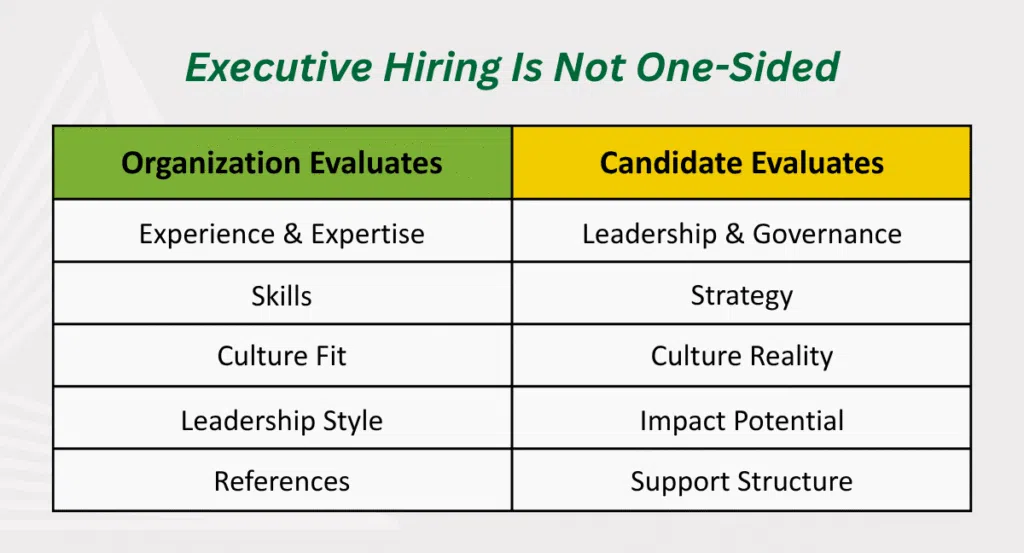
Executive hiring is no longer a one-sided assessment. The most effective leaders are evaluating organizations with the same rigor used to evaluate them.
They are assessing leadership quality, strategy, governance, culture, and their ability to create impact—often before the first formal interview.
For organizations in food and agriculture, this shift presents both a challenge and an opportunity. Those that intentionally articulate and demonstrate a strong leadership environment are far better positioned to attract and retain top-tier talent.
The question is no longer simply whether a candidate is the right fit for the organization. Increasingly, top candidates are deciding whether the organization is the right fit for them.
If you are evaluating how your organization is perceived by executive talent—or preparing for a critical leadership hire—we welcome the opportunity to share perspectives from the market and discuss what today’s top candidates are truly looking for.
Kincannon & Reed incorporates validated interview techniques and evaluation tools to accurately assess candidates. We have the capability to measure personality traits, motivations and evaluate specific competencies and behaviors. The right assessments provide a balanced approach to understanding potential as much as experience.
Coaching empowers executives to reach their full potential faster, benefiting your organization. We partner certified coaches with executives and use a strengths-based approach to guide leaders through a process that maximizes their potential to drive success.
We bring a history of success delivering advisory and fiduciary board members specifically for family, start-up, and growth organizations. Our industry networks and broad access to executive leadership bring willing candidates from every corner of the market to serve on your board.