Enterprise leadership is not a continuation of functional success; it is a fundamental shift in how leaders create impact.
For much of a leader’s career, experience is a reliable predictor of performance. Leaders build credibility by solving problems, delivering results, and developing deep expertise within a function or industry. Over time, that experience becomes a powerful asset.
But at the enterprise level, experience alone stops being enough.
As organizations scale, the nature of leadership changes. Complexity accelerates, decision-making becomes less defined, and success depends less on what a leader has seen before and more on how they think, adapt, and influence across the organization.
McKinsey research on the “adaptability paradox” highlights a common trap: precisely when leaders face the most uncertainty and complexity, they tend to fall back on the familiar approaches that made them successful before—rather than the fresh thinking the moment requires.
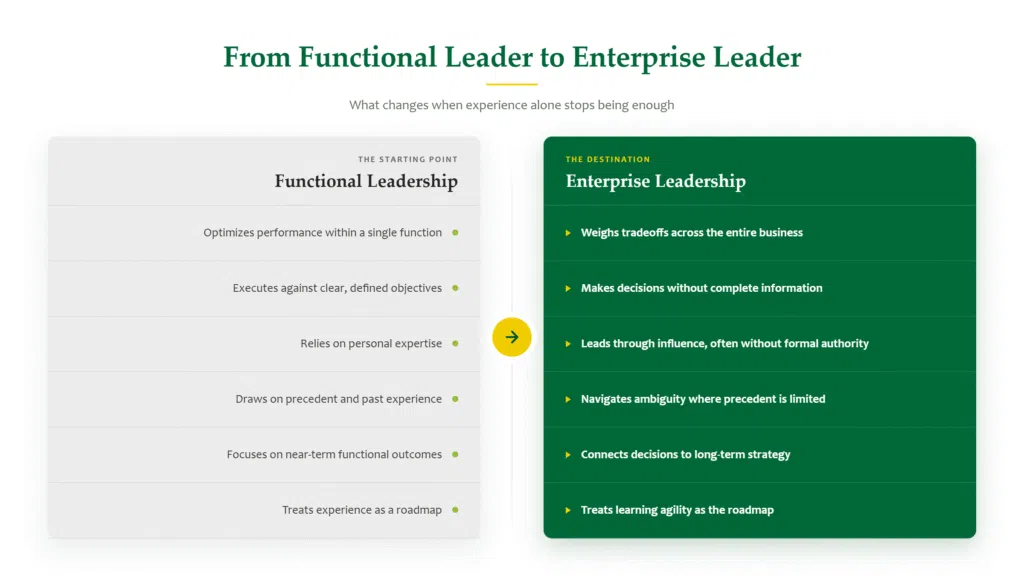
Typically, leaders rise through the organization by excelling within a specific domain. They know how to optimize performance, manage teams, and execute against clear objectives.
At the enterprise level, the expectations shift.
As a result, decisions are no longer confined to a single function. Leaders must weigh tradeoffs across the entire business, balancing short-term performance with long-term strategy, and functional priorities with organizational impact.
This requires a broader lens:
The complexity is not just greater; it is fundamentally different.
Senior leaders operate in environments where precedent is limited and clarity is rare. They are expected to navigate competing stakeholder expectations, increasing regulatory scrutiny, global operations, and ongoing transformation—all at once.
In food and agriculture, this is especially pronounced. Leaders are simultaneously responding to shifting consumer expectations, sustainability pressures, supply chain disruption, and evolving policy environments. The World Economic Forum notes that global food systems are under mounting pressure from forces including climate change, geopolitical shifts, and energy challenges, adding layers of uncertainty to already complex operating models.
In this context, experience provides context but not necessarily answers. Ultimately, success hinges more on a leader’s ability to interpret new situations, connect disparate inputs, and act decisively without a clear playbook.
As leaders move higher in the organization, their ability to directly control outcomes diminishes. What replaces it is the need to lead through influence.
Enterprise leaders must align stakeholders across functions, communicate direction with clarity, and ensure accountability through others, often without formal authority. This requires a shift from relying on personal expertise to building shared ownership. Leaders who struggle at this level are often those who continue to default to what made them successful earlier in their careers: being the most knowledgeable person in the room, rather than the one who enables the room to move forward together.
In stable environments, experience provides a roadmap. In dynamic environments, it can become a constraint.
Enterprise leaders must be able to:
As Harvard Business Review notes, learning agility—the skill of learning from experience to succeed in unfamiliar situations—is an increasingly sought-after capability as careers and businesses grow less linear and predictable.
This is particularly relevant in food and agriculture, where leaders are navigating shifting demand, sustainability expectations, and global supply chain volatility simultaneously.
Traditional executive evaluation often emphasizes experience, i.e. roles held, results delivered, and career progression. While these indicators provide valuable context, they rarely offer a complete picture of readiness for enterprise leadership.
In addition, leadership assessment adds a more forward-looking dimension. It helps organizations evaluate how leaders think, adapt, communicate, and influence—capabilities that become critical as complexity increases. Consequently, by assessing areas such as strategic thinking, learning agility, and decision-making approach, organizations gain clearer insight into whether a leader can scale with the business, not just succeed within a familiar scope.
Experience will always matter. But at the enterprise level, it is only part of the equation.
The more relevant question is not whether a leader has done the job before, but whether they have the capacity to lead at a higher level of complexity.
As a result, organizations that make this shift tend to build stronger leadership pipelines, make more effective executive hires, and position themselves for sustained growth.
If this perspective aligns with challenges you are seeing in your leadership pipeline, we would welcome the opportunity to compare notes and share what we are seeing across the market.
Kincannon & Reed incorporates validated interview techniques and evaluation tools to accurately assess candidates. We have the capability to measure personality traits, motivations and evaluate specific competencies and behaviors. The right assessments provide a balanced approach to understanding potential as much as experience.
Coaching empowers executives to reach their full potential faster, benefiting your organization. We partner certified coaches with executives and use a strengths-based approach to guide leaders through a process that maximizes their potential to drive success.
We bring a history of success delivering advisory and fiduciary board members specifically for family, start-up, and growth organizations. Our industry networks and broad access to executive leadership bring willing candidates from every corner of the market to serve on your board.