Organizations invest significant time and resources identifying high-potential talent. Yet one of the most common leadership development challenges isn’t finding capable leaders—it’s preparing them for the broader responsibilities that come with enterprise-level roles. Cross-functional experience plays a critical role in that process, helping leaders develop the enterprise perspective needed to navigate complexity, align diverse stakeholders, and make broader business decisions.
Many leaders excel within their function. They build deep expertise, deliver strong results, and earn increased responsibility. But as organizations grow and leadership roles become more complex, success requires a different perspective. Enterprise leaders must balance competing priorities, understand how decisions affect the broader organization, and align diverse teams around a common strategy. Developing those capabilities often requires exposure beyond a leader’s primary area of expertise.
This is where cross-functional experience becomes one of the most valuable tools in building executive-ready leaders.
As leaders advance, the scope of their decisions expands. A functional leader may focus on optimizing results within a specific area of the business. An enterprise leader, however, must consider how decisions affect customers, operations, finance, talent, supply chains, innovation, and long-term strategy at the same time.
The challenge is that many leaders spend much of their careers operating within a single discipline. While deep expertise remains important, enterprise leadership requires the ability to see connections across the organization and understand how each function contributes to overall success. Leaders who have experienced different parts of the business often develop that broader lens more naturally, which helps them navigate complexity with more confidence and clarity.
Functional silos are one of the most persistent barriers to organizational effectiveness.
They form naturally as teams focus on specific goals and metrics, but they often lead to misalignment at the enterprise level.
Cross-functional experience helps leaders:
Leaders who understand multiple parts of the business are better equipped to make decisions that optimize the whole—not just a single function.
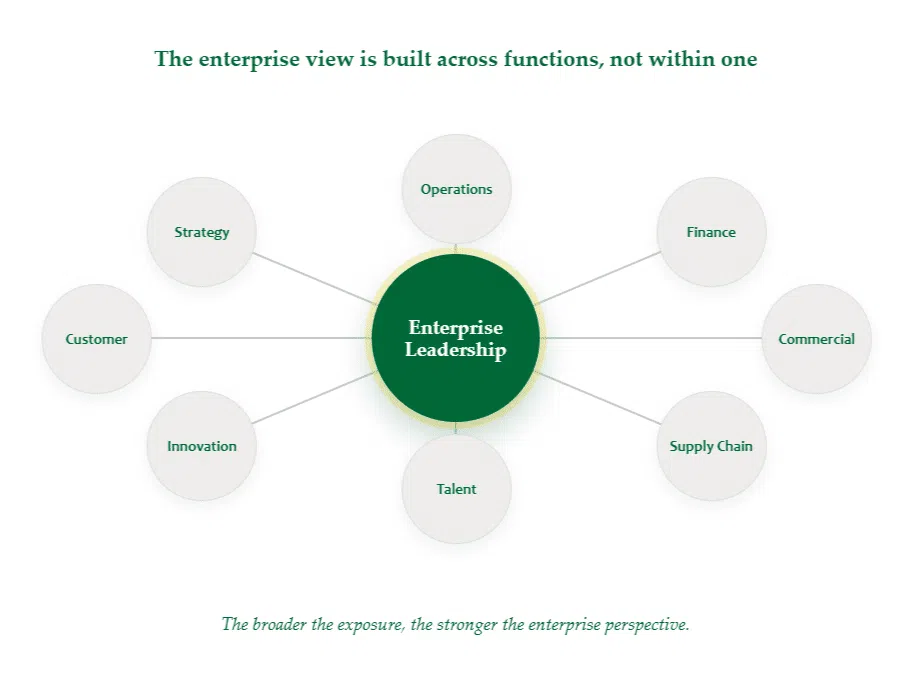
Enterprise leadership is rarely about solving isolated problems. Leaders must continuously connect individual decisions to broader organizational outcomes, which means they need to think in systems rather than in silos.
Cross-functional experience strengthens this capability by exposing leaders to different ways of thinking, measuring success, and evaluating risk. A commercial leader who gains exposure to operations may better understand execution constraints. An operations leader who works closely with finance may develop a deeper appreciation for capital allocation decisions. A functional expert who participates in enterprise-wide initiatives often gains insight into how strategic decisions are evaluated across the organization.
Over time, those experiences help leaders move from functional problem-solvers to enterprise thinkers. McKinsey has noted that leaders need more than individual capability; they also need the ability to build agility into the design and culture of the organization itself.
Many leadership transitions fail not because individuals lack capability, but because the complexity of the role exceeds their previous experience. Enterprise leaders are expected to manage ambiguity, balance competing stakeholder interests, and make decisions with incomplete information.
Cross-functional experiences can help prepare leaders for those realities before they assume senior executive roles. Leading enterprise-wide initiatives, participating in cross-functional project teams, rotating through different business units, or gaining exposure to new markets and geographies all help broaden a leader’s perspective. These opportunities build the adaptability and judgment needed to succeed at higher levels.
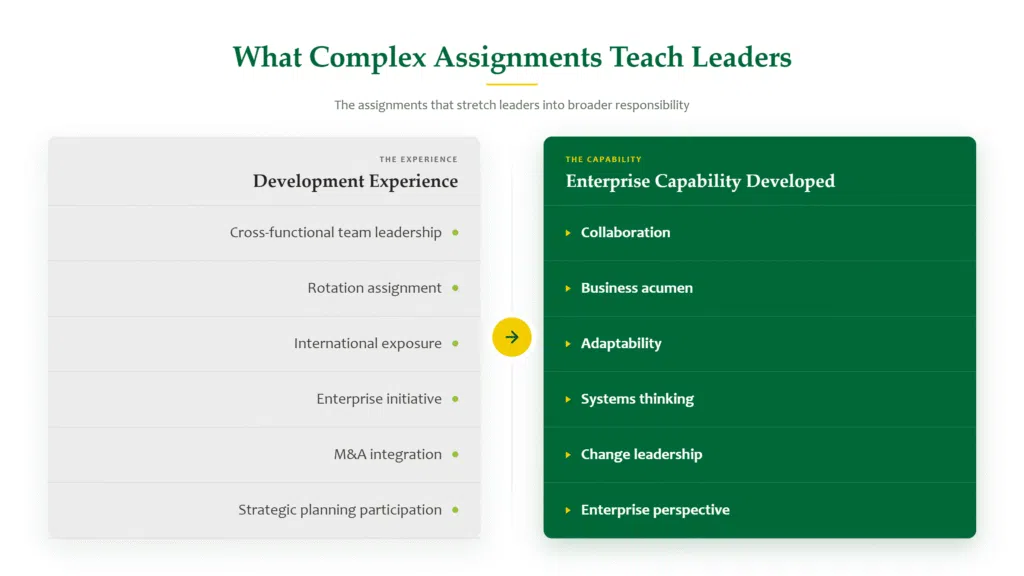
Succession planning often focuses on identifying future leaders. Equally important is preparing them.
Organizations frequently find that high-performing leaders are narrowly developed—strong in their function, but less experienced across the enterprise.
By intentionally building cross-functional exposure, organizations:
In industries like food and agriculture—where leaders must navigate supply chains, regulatory complexity, sustainability, and market volatility—this breadth is increasingly a competitive advantage.
This challenge is especially relevant in food and agriculture, where leaders must navigate market volatility, evolving regulations, workforce challenges, global supply chains, sustainability initiatives, and changing customer expectations. The World Economic Forum has emphasized that food systems transformation requires leaders to take a systems-level view, engage diverse stakeholders, and align around shared goals.
Organizations that develop leaders with broad business exposure are often better positioned to respond to those challenges. They are also more likely to have a strong bench of leaders prepared to step into enterprise-level roles when opportunities arise.
Functional expertise will always be valuable. Organizations need leaders with deep knowledge and strong execution capabilities. However, enterprise leadership requires more than excellence within a single discipline.
Leaders who can understand the broader business, connect strategy to execution, build alignment across functions, and navigate complexity are often the ones who succeed at the highest levels. Cross-functional experience is not simply a development opportunity; it is one of the most effective ways organizations can prepare leaders for the realities of enterprise leadership.
For organizations focused on leadership readiness, succession planning, and long-term growth, the question may not be whether high-potential leaders need cross-functional exposure. The question is whether they are receiving enough of it soon enough.
If strengthening executive readiness is a priority for your organization, we’d welcome the opportunity to continue the conversation.
Kincannon & Reed incorporates validated interview techniques and evaluation tools to accurately assess candidates. We have the capability to measure personality traits, motivations and evaluate specific competencies and behaviors. The right assessments provide a balanced approach to understanding potential as much as experience.
Coaching empowers executives to reach their full potential faster, benefiting your organization. We partner certified coaches with executives and use a strengths-based approach to guide leaders through a process that maximizes their potential to drive success.
We bring a history of success delivering advisory and fiduciary board members specifically for family, start-up, and growth organizations. Our industry networks and broad access to executive leadership bring willing candidates from every corner of the market to serve on your board.