By Managing Director Carolyn Schubert
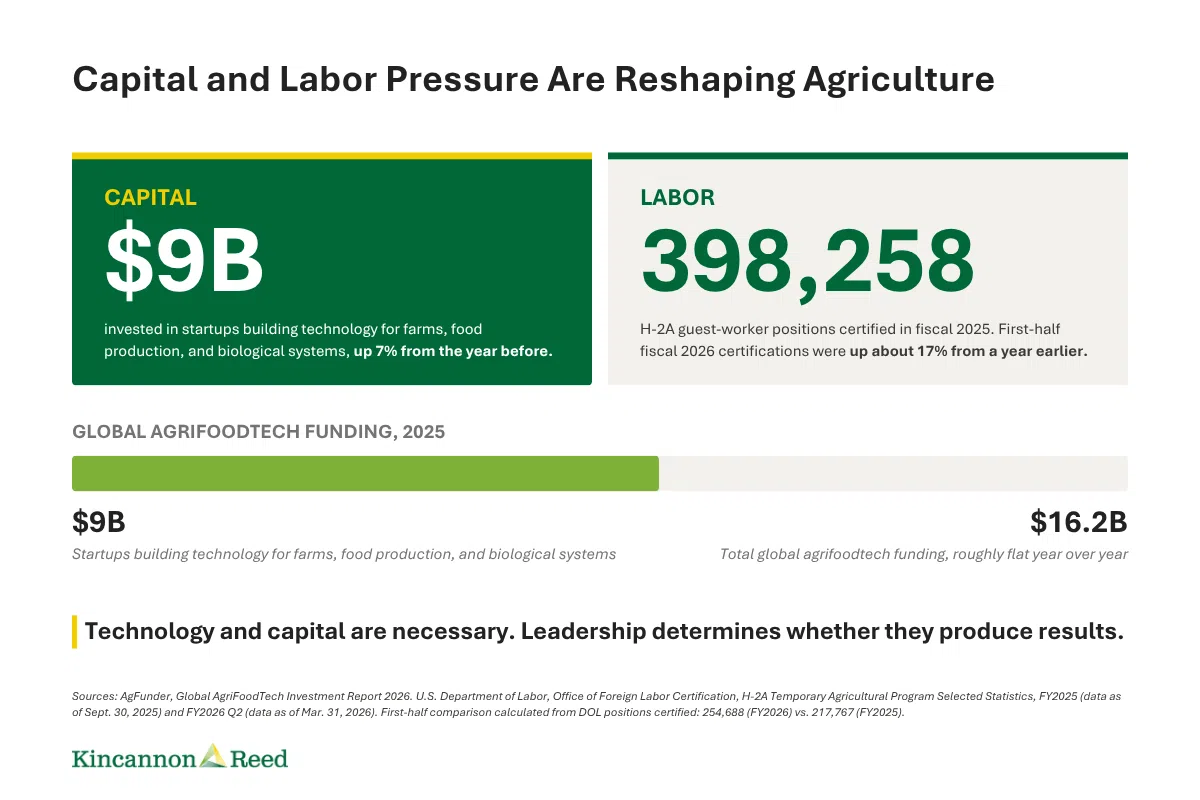
Food and agriculture leadership is being tested as companies operate in a different environment than they were two years ago. Capital has concentrated in farm automation, biological inputs, livestock technology, and precision tools. Global agrifoodtech funding was roughly flat in 2025 at $16.2 billion, yet startups building technology for farms, food production, and biological systems drew $9 billion, up 7% from the year before.1 Labor shortages continue to push producers toward robotics and data-driven systems. That pressure is most visible in labor-intensive crops, where harvest has long depended on hand labor. Federal H-2A guest-worker certifications reached 398,258 positions in fiscal 2025, and certifications in the first half of fiscal 2026 were up about 17% from a year earlier, with nearly four in five for crop, nursery, and greenhouse workers.2
At the same time, an aging executive workforce and thin succession pipelines are colliding with the need for new commercial, technical, and enterprise skills. The result is a widening gap between the opportunities in front of organizations and the leadership benches required to capture them. Companies that treat talent as a lagging operational issue rather than a strategic priority will struggle to convert current momentum into durable results. Cargill Board Chair and CEO Brian Sikes recently framed the stakes clearly: “What if developing the world’s best talent is the key to unlocking our food systems’ greatest opportunities?” That question sits at the center of the current moment. Technology and capital are necessary. Leadership determines whether they produce results.
Three overlapping forces are reshaping executive requirements across the food and agriculture value chain. First, agtech is moving faster from pilot to scale. Investors have directed later-stage capital toward companies that can demonstrate unit economics in robotics, ultra-precision spraying, virtual fencing and livestock monitoring, biologicals, and AI-enabled decision tools.3 These businesses now need operators who can professionalize go-to-market, manage channel relationships with dealers, growers, packers, shippers, and cooperatives, integrate technology into existing farm systems, and build repeatable processes. Technical founders and early commercial hires often lack the enterprise experience required at this stage.
Second, established agribusinesses, processors, and input companies are adding new capabilities while managing commodity-cycle volatility. Equipment manufacturers, crop protection and seed firms, animal health businesses, and ingredient companies are investing in automation, biological alternatives to synthetics, sustainability reporting, and data platforms. They need leaders who understand both the traditional business and the new technologies—people who can drive adoption without disrupting core operations. In perishable crops, that also means managing water availability, labor regulation, food safety, and concentrated retail and foodservice customers.
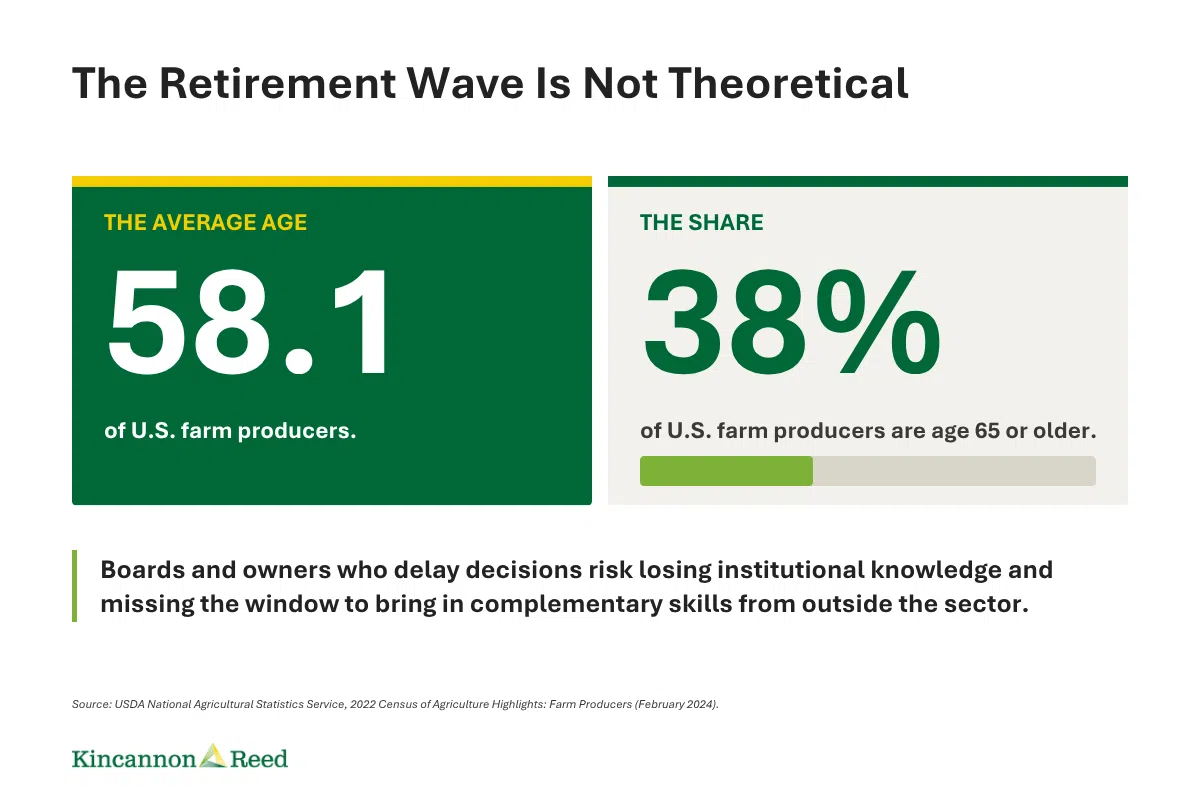
Third, demographic and ownership realities are creating urgency around succession. Many family-owned producers, cooperatives, and mid-sized companies have long-tenured leaders approaching retirement. USDA’s 2022 Census of Agriculture put the average age of U.S. farm producers at 58.1, with 38% age 65 or older, and family-owned grower-shippers in produce are no exception.4 Formal succession plans remain uncommon. Boards and owners who delay decisions risk losing institutional knowledge and missing the window to bring in complementary skills from outside the sector. Private-equity and venture-backed portfolio companies face a distinct version of the same problem. Capital creates opportunity; leadership determines whether that opportunity is captured. Funds that treat executive hiring as a checklist item after a deal closes often discover the cost of misalignment later.
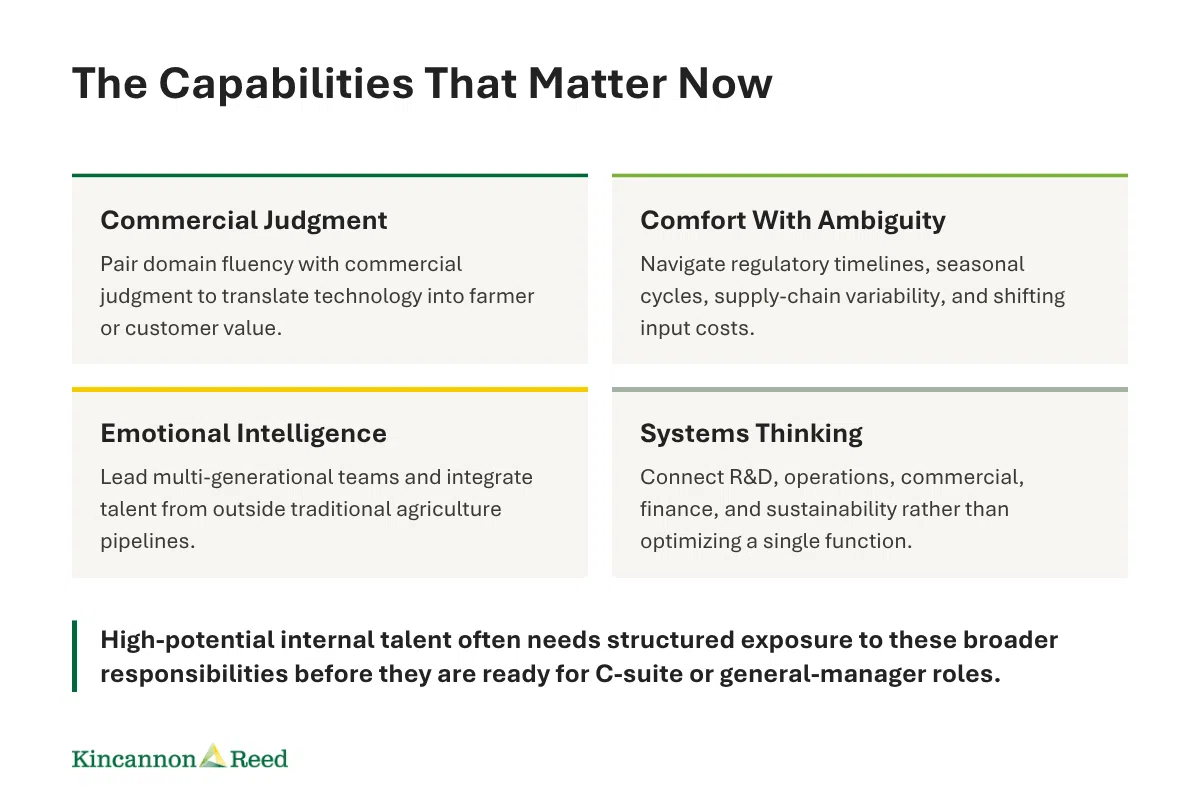
The food and agriculture leaders who succeed in this environment share a consistent profile that goes beyond functional expertise. They combine domain fluency with commercial judgment. They can translate technology into farmer or customer value and build the relationships that drive adoption in a relationship-driven industry. They operate comfortably with ambiguity—navigating regulatory timelines, seasonal cycles, supply-chain variability, and shifting input costs. In perishable crops, those calls are often made in days rather than seasons. They possess the emotional intelligence required to lead multi-generational teams and integrate talent from outside traditional agriculture pipelines.
Enterprise-level leaders must also demonstrate systems thinking. They connect R&D, operations, commercial, finance, and sustainability rather than optimizing a single function. High-potential internal talent often needs structured exposure to these broader responsibilities before they are ready for C-suite or general-manager roles. Organizations that continue to hire primarily against yesterday’s job descriptions will find themselves competing for a shrinking pool of familiar candidates while the market moves toward a different set of skills.
Companies that treat leadership as a strategic asset rather than a reactive search are already changing how they approach the problem. They start with a clear-eyed assessment of current capability against the next three to five years of strategy, not just current vacancies. They map internal high-potential talent against future requirements and identify where development assignments, coaching, or external hires are needed. They look beyond the usual networks when the required combination of skills is scarce, then invest in onboarding so that cross-industry or non-traditional candidates can contribute quickly. They also address succession as an ongoing process rather than an event triggered by a retirement announcement. This includes board-level discussion of leadership risk, scenario planning for key roles, and a realistic view of which internal candidates can be ready in time. For PE-backed and high-growth companies, the most effective funds align on leadership requirements during diligence or immediately after close, then move quickly to install or upgrade the team. Waiting until operational issues appear costs more.
Generalist search firms rarely possess the industry context required to evaluate candidates accurately in food and agriculture. The difference shows up in cultural fit, speed of contribution, and retention. Leadership solutions that go beyond placement—assessment, onboarding, coaching, and succession planning—reduce the risk that a successful search fails in execution. The current window is time-sensitive and the retirement wave is not theoretical. Companies that build or upgrade their food and agriculture leadership benches now will be better positioned to convert these conditions into results.
Kincannon & Reed works exclusively with organizations across the food and agriculture value chain. We combine retained executive and board search with leadership assessment, development, and succession support. If you are evaluating talent strategy for a family-owned producer or an established agribusiness adding new capabilities, we’d welcome a conversation about current market dynamics and leadership implications to help clarify next steps.
1 AgFunder, Global AgriFoodTech Investment Report 2026 (agfunder.com/research/agfunder-global-agrifoodtech-investment-report-2026/).
2 U.S. Department of Labor, Office of Foreign Labor Certification, H-2A Temporary Agricultural Program Selected Statistics, FY2025 (data as of September 30, 2025) and FY2026 Q2 (data as of March 31, 2026). First-half comparison calculated from DOL positions certified: 254,688 (FY2026) vs. 217,767 (FY2025).
3 New Market Pitch, “What are the most valuable AgriTech startups?”, September 2026
4 USDA National Agricultural Statistics Service, 2022 Census of Agriculture Highlights: Farm Producers (February 2024).