By Managing Director Sally Day
I attended the 2026 Women in Agribusiness Summit in New Orleans with two things in mind: reconnecting with people across the industry and listening for the conversations that matter most to leaders and the organizations they serve.
There was plenty to listen to.
This year marked the 15th anniversary of Women in Agribusiness, with attendees representing 41 states and 15 countries. About half of those attending hold executive positions, and 28 students were there through scholarship support from agribusiness organizations. I was struck by the range of experience in the room—from students attending their first conference to highly seasoned executives—and by how readily people made connections across those different stages of their careers.
For me, though, one of the most meaningful parts of the Summit was the opportunity to moderate the Executive Profiles Panel.
I was joined by three remarkable women – Heather Anfang, EVP & President, Dairy Foods at Land O’Lakes; Abbey Perkins, EVP at StoneX Group, Inc.; and Jaine Chisholm Caunt OBE, Director General at Gafta – whose paths to leadership could hardly have been more different. One spent 27 years there. Another moved from academia into trade association leadership. The third built a career across finance, IT, operations and executive leadership.
Different industries. Different experiences. Different career decisions.
And yet, as we talked, a common theme emerged: careers make a lot more sense looking backward.
I started the conversation by asking the panelists to think about their careers as a story.
If your career were a movie, what would the title be?
The point wasn’t to come up with a clever title. It was to remind the audience that the title of your career today probably isn’t the title you would have chosen at 25.
When we’re early in our careers, we tend to think about progression in fairly linear terms. We get a role, perform well, earn a promotion and move to the next role. But that’s not how most careers actually happen.
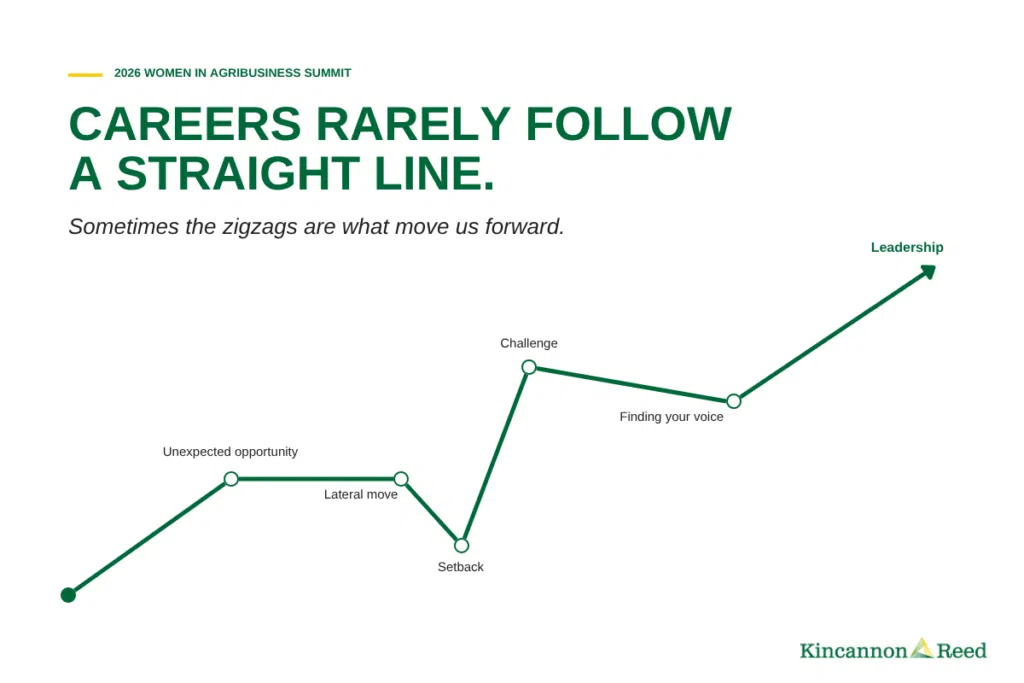
The panelists talked about unexpected opportunities, sideways moves, risks, setbacks and decisions that made sense for their lives at a particular point in time. Looking backward, those moments formed a much clearer path than they probably felt like at the time.
One of the panelists described her career as a “zigzag”, acknowledging that a career isn’t necessarily a straight shot upward. Sometimes growth means moving sideways. Sometimes it means taking a step back to take a step forward. Sometimes the opportunity that ultimately changes your career is the one you never would have put on your original plan.
One of the things I found particularly interesting was how each panelist had a moment when she had to take control of her own career.
For one, that meant raising her hand for an extraordinarily challenging business assignment—one where the outcome was far from certain.
Another took on a program that had essentially been labeled a “poison chalice.”
And another had to be encouraged to ask for the promotion she had earned.
Those stories were different, but they all pointed to the same idea: at some point, you have to participate actively in shaping your career.
It’s easy to assume that doing good work will automatically lead to recognition and advancement.
Doing good work matters enormously. But there also comes a point when you have to make your ambitions visible. You have to say what you want. You have to raise your hand for the assignment. You have to ask the question.
Hard work can build your credibility. Advocacy helps make sure people know what you’re ready to do with it.
Another part of the conversation that stayed with me was the idea that we sometimes define career growth too narrowly.
We tend to look at a new title or greater responsibility as the obvious marker of progress.
But some of the most important growth can happen without either.
A lateral move can expose you to an entirely different part of an organization. A difficult assignment can stretch your leadership in ways a promotion doesn’t. A role that looks like a step backward on paper may give you experience that ultimately makes you a much stronger leader.
And sometimes, personal circumstances influence those choices.
One of the panelists talked about taking a job-share arrangement when she had young children. At the time, she worried that the decision might derail her career. It didn’t. It became one chapter in a much longer leadership story.
That story resonated with me because careers don’t happen separately from the rest of our lives.
People make career decisions while they’re raising families, caring for parents, relocating, navigating personal priorities or simply figuring out what they want next.
Those decisions shouldn’t automatically be viewed as compromises. Sometimes they’re simply part of the zigzag.
We also talked about something that I think is particularly important for women in leadership: when do you find your voice?
And perhaps more importantly, when do you realize that working hard isn’t enough?
Each panelist had her own version of that moment.
Finding your voice doesn’t necessarily mean becoming the loudest person in the room. It can mean being willing to express an opinion, ask for an opportunity, negotiate for what you need or tell someone where you want your career to go.
Those can be uncomfortable things to do.
But leadership requires more than delivering results. It requires the willingness to be seen, to make decisions and, sometimes, to advocate for yourself.
I went to the Summit interested in leadership development, career development and the broader issues affecting agriculture. I attended sessions on the state of the industry, leadership, career progression, interviewing and even how AI is affecting leadership.
But I left thinking about something much more fundamental.
We spend a lot of time talking about leadership pipelines. We talk about identifying high-potential talent, developing successors and preparing people for the next role.
All of that matters.
But we also need to recognize that the people we’re developing won’t necessarily follow the path we imagine for them.
Their careers will zigzag.
They’ll take unexpected opportunities. They’ll make personal decisions that affect their careers. They’ll have setbacks. They’ll discover strengths they didn’t know they had. They’ll change direction.
Our job as leaders isn’t to prescribe every turn.
It’s to help people recognize their strengths, understand their options, build the confidence to make thoughtful choices and be ready when an unexpected opportunity comes along.
That’s one of the reasons I value events like Women in Agribusiness so much. The formal sessions are important, but so are the conversations between them—the introductions, the advice, the stories shared over coffee and the connections between women at very different points in their careers.
Because sometimes the most useful career advice isn’t a roadmap.
It’s a reminder that you don’t need one.
Your career may not make perfect sense while you’re living it. But give it time, and you may look back and realize that the zigzags were exactly what helped you get where you needed to go.
If you’re thinking about how to develop your leaders, strengthen your leadership pipeline or prepare your organization for what comes next, I’d welcome the opportunity to continue the conversation. Connect with me to talk about your organization’s leadership needs.