Artificial intelligence is changing executive search in two important ways: it is reshaping the leadership capabilities organizations need, and it is making conventional hiring signals—from résumés to polished interview responses—less conclusive on their own.
For food and agriculture companies, the response is not less technology in the hiring process. It is more rigorous, human-led assessment of judgment, AI fluency, and the ability to lead through change.
As AI becomes more embedded in business operations, leadership teams are asking important questions: What should AI fluency mean for an executive? How can boards and hiring committees distinguish genuine capability from polished presentation? And how should organizations assess leaders whose roles may evolve as quickly as the technology itself?
The answer begins with a simple premise: AI can strengthen executive search, but it cannot replace the human work of understanding how a leader thinks, decides, learns, and earns trust.
For decades, executive hiring has relied on familiar signals: career progression, functional experience, academic and company pedigree, interview performance, references, and a candidate’s ability to articulate a compelling leadership story.
Those signals still matter. But they are no longer sufficient on their own.
Generative AI can help candidates improve application materials, organize their thinking, prepare for interviews, and communicate ideas with greater clarity. Used responsibly, that is not inherently a concern. In fact, a leader’s thoughtful use of AI may reflect the practical capabilities organizations increasingly need.
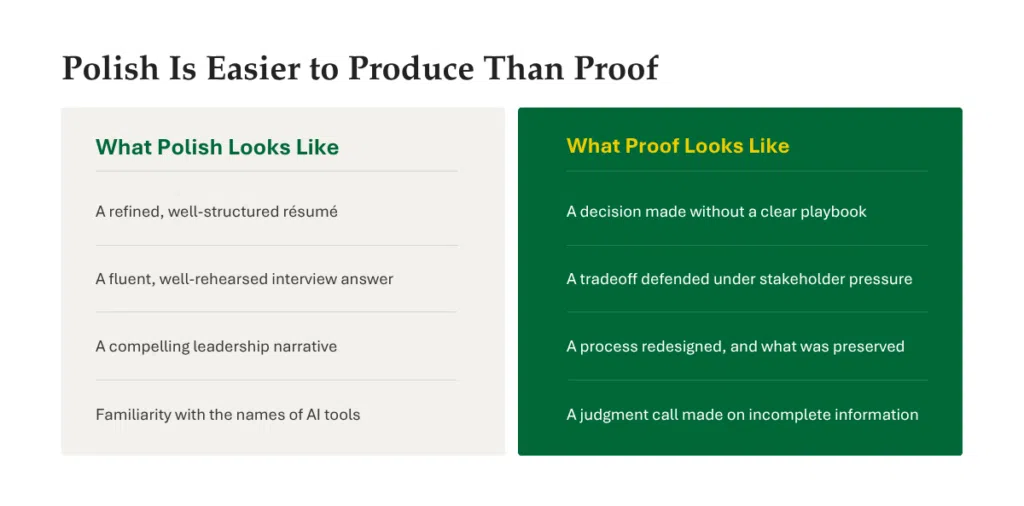
The challenge is that polish is easier to produce than proof. As generative AI makes it easier for candidates to refine résumés and prepare highly structured interview responses, traditional hiring signals are becoming less conclusive when considered in isolation.
At the executive level, a strong résumé or highly prepared interview response does not necessarily demonstrate the judgment required to navigate ambiguity, balance competing stakeholder interests, or make high-consequence decisions without a clear playbook.
That distinction is especially important in food and agriculture. Leaders in this sector operate across complex supply chains, relationship-driven markets, biological systems, changing regulations, global economic pressures, and a wide range of stakeholder expectations. A decision involving AI-enabled demand planning, food safety, procurement, pricing, customer service, or supply-chain visibility can have implications well beyond one function or business unit.
For boards, CEOs, and hiring teams, the question is shifting from, “Does this executive look qualified?” to, “How does this executive think, decide, and lead when the answer is not obvious?”
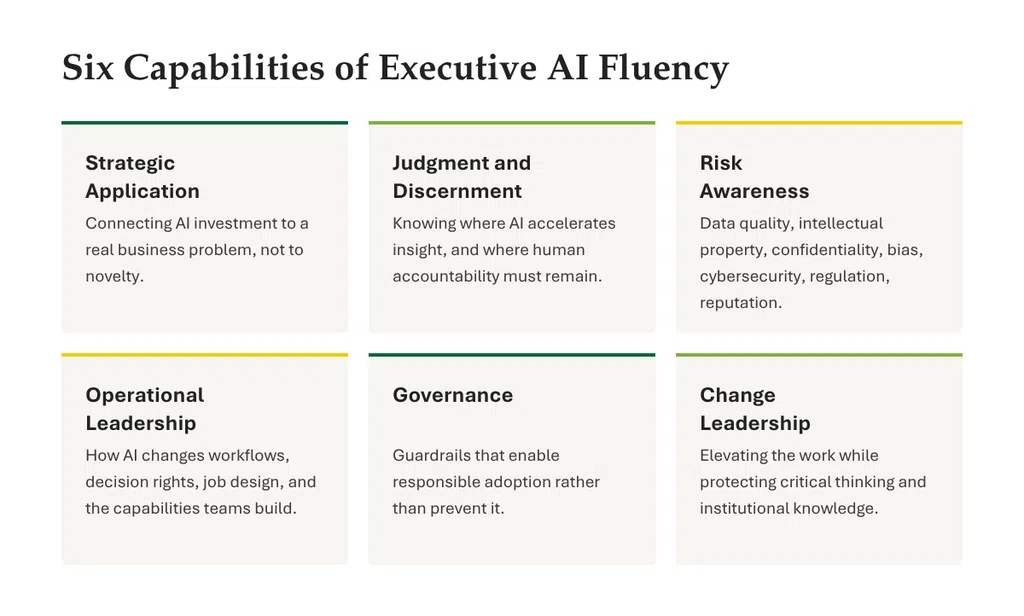
AI fluency for an executive is not the ability to use every new tool. It is the ability to recognize where AI can create business value, understand its limitations and risks, apply appropriate governance, and lead people through the changes it creates.
At the C-suite and board level, AI fluency is ultimately a test of strategic judgment, not software proficiency. It requires leaders to connect AI opportunity to business value, establish appropriate guardrails, and help their organizations adopt new capabilities responsibly. Building executive AI fluency also requires attention to governance, data ethics, and organizational capability—priorities explored in our perspective on AI-powered leadership in food and agriculture.
A leader does not need to be a data scientist or an AI engineer to lead effectively in an AI-enabled organization. However, they do need to understand enough to ask the right questions, challenge incomplete answers, identify meaningful opportunities, and establish accountability for how new tools are used.
For executive candidates, meaningful AI fluency often shows up in six related capabilities:
In food and agriculture, these capabilities are not theoretical. A leader considering AI-enabled forecasting, for example, must understand more than the promise of better predictions. They must consider the quality and availability of underlying data, the impact on inventory and production decisions, the implications for grower or supplier relationships, and the human judgment required when markets, weather, biology, or customer behavior do not follow a predictable pattern.
The strongest leaders will not treat AI as a substitute for expertise. They will use it to make expertise more productive, informed, and scalable.
As AI makes traditional hiring signals easier to enhance, executive assessment needs to move closer to evidence.
That does not mean treating every candidate with suspicion. It means designing a process that helps boards and hiring teams see beyond presentation and understand how an executive has created value in practice.
Rather than asking only, “Which AI tools have you used?” consider exploring how a candidate has led through technological, operational, or market change. The most revealing conversations tend to be specific, behavioral, and grounded in real experience.
For example:
Scenario-based assessment can also be valuable. A realistic business discussion—such as responding to a supply disruption, managing a food-safety event, integrating an acquisition, evaluating a new commercial opportunity, or handling sensitive grower, employee, or customer data—can reveal far more than a polished response to a general interview question.
The goal is not to find one “correct” answer. It is to understand how the candidate frames the problem, gathers relevant perspectives, identifies risks, weighs tradeoffs, and creates alignment around a decision.
For boards and leadership teams, evaluating AI readiness in an executive candidate does not require a separate technical interview. It requires clearer criteria for the leadership behaviors that matter most.
| Executive capability | What to assess | Sample question |
| Judgment | Whether the candidate knows where AI can add value—and where human accountability must remain decisive | “Describe a decision in which technology improved the information available, but did not determine the final decision.” |
| Strategic application | Whether the candidate connects AI to business priorities rather than novelty | “Where would you test AI first in this organization, and what outcomes would determine whether it should scale?” |
| Governance | Whether the candidate recognizes privacy, quality, bias, intellectual-property, and regulatory considerations | “Where would you set boundaries around AI use, and how would you create effective oversight?” |
| Change leadership | Whether the candidate can build trust, capability, and accountability across teams | “How would you help leaders and employees use AI productively without weakening critical thinking?” |
This approach provides stronger evidence than self-reported familiarity with technology alone.
Consider a candidate who describes AI as a way to improve forecasting, scenario planning, or customer responsiveness. The most compelling executive is not necessarily the person who can describe the most platforms. It is the leader who can explain the business problem, define the operating and data constraints, identify the decisions that should remain human-led, and articulate how the organization will know whether the investment is improving outcomes.
That is the difference between using AI and leading with it.
While AI can strengthen research, information synthesis, and parts of the search process, it cannot replace the human judgment required to assess leadership potential, cultural alignment, and the ability to build trust.
Food and agriculture organizations are adopting AI amid a broader set of leadership pressures: market volatility, margin constraints, supply-chain complexity, labor challenges, regulatory change, sustainability expectations, shifting consumer demand, and the need to innovate without losing sight of core operations.
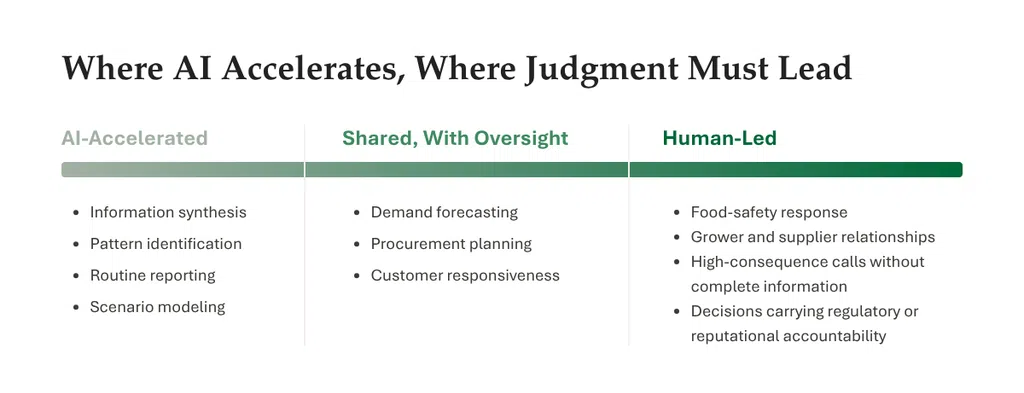
AI can create meaningful leverage in this environment. It can help organizations synthesize information, improve planning, identify patterns, automate routine work, and support better decisions. But it also raises important questions about data integrity, governance, operational risk, stakeholder trust, and accountability.
These are leadership questions.
The executives best positioned to lead through this period will combine technological openness with deep business and sector judgment. They will be curious enough to explore what is possible, disciplined enough to recognize where risk is unacceptable, and thoughtful enough to bring people with them through change.
They will also understand that not every decision should be automated, optimized, or accelerated. Some decisions require experience, context, relationships, and accountability that cannot be delegated to a model. Organizations will also need to protect judgment and critical-thinking capabilities as AI becomes more embedded in everyday work.
For organizations that depend on trust—with growers, producers, employees, customers, investors, regulators, and communities—that distinction matters.
Executive search should be more than a process for filling an open role. It is an opportunity to define the leadership capabilities the business will need next.
That means looking beyond a candidate’s past titles, credentials, and functional experience to assess whether they can:
AI will continue to influence both the candidate experience and the work leaders are being hired to do. The appropriate response is not to assume executive search has become less trustworthy. It is to recognize that familiar signals require stronger validation.
At its best, executive search gets beneath presentation and into leadership substance: how an individual has created value, navigated complexity, learned from setbacks, exercised judgment, and earned the confidence of those around them.
For food and agriculture organizations, that work has never been more important. The leaders who will create the greatest value will not simply be those who embrace every new tool. They will be those who understand where technology can create leverage—and where human judgment must lead.
What does AI fluency mean for an executive?
For executives, AI fluency means understanding where AI can create business value, where its limitations and risks require oversight, and how to lead teams through AI-enabled changes in work, operations, and decision-making.
Should executive candidates be expected to be AI experts?
Not necessarily. Most executive roles do not require technical AI expertise. They do require the judgment to connect AI investments to strategic priorities, establish appropriate governance, ask informed questions, and build organizational capability.
How can boards assess AI fluency in executive candidates?
Boards should look beyond self-reported tool use. Behavioral interviews, realistic business scenarios, reference conversations, and questions about governance, adoption, and decision-making can provide stronger evidence of how a candidate leads with AI.
Why does AI fluency matter in food and agriculture?
Food and agriculture organizations operate across complex supply chains, regulated environments, biological systems, and relationship-driven markets. Leaders must be able to pursue AI’s potential responsibly while protecting product quality, data integrity, stakeholder trust, and long-term value.
Kincannon & Reed incorporates validated interview techniques and evaluation tools to accurately assess candidates. We have the capability to measure personality traits, motivations and evaluate specific competencies and behaviors. The right assessments provide a balanced approach to understanding potential as much as experience.
Coaching empowers executives to reach their full potential faster, benefiting your organization. We partner certified coaches with executives and use a strengths-based approach to guide leaders through a process that maximizes their potential to drive success.
We bring a history of success delivering advisory and fiduciary board members specifically for family, start-up, and growth organizations. Our industry networks and broad access to executive leadership bring willing candidates from every corner of the market to serve on your board.