By Managing Director Jon Lowe
The animal health industry is entering a period of meaningful change. Innovation is increasingly coming from outside traditional organizational boundaries, competitive dynamics are intensifying, and the capabilities that once defined successful leadership are evolving alongside the business.
Conversations coming out of the 2026 KC Animal Health Summit highlighted several interconnected shifts: the growing influence of startups and external innovation, the increasing importance of technology and data, faster generic competition, and a widening need for leaders who bring perspectives and experiences from beyond traditional animal health.
Taken together, these trends point to a clear leadership implication: what made someone successful in the industry yesterday may not be enough to lead effectively tomorrow.
Animal health historically benefited from significant innovation originating within large human health companies. As the industry matured and companies separated from their former parent organizations, it became more expensive for that internal innovation engine to carry the entire pipeline.
Today, startups, universities, venture capital, private equity and strategic partnerships are playing a much larger role. The startup landscape itself is also changing. Once consisting primarily of early-stage companies with an idea or molecule, more emerging businesses are reaching commercialization and developing viable business models.
That evolution changes the leadership challenge.
For executives, managing innovation increasingly means managing relationships, partnerships and ecosystems. Leaders may need to work with founders, investors, academic institutions and organizations whose cultures and operating models look very different from those of a traditional animal health company.
That requires more than technical or functional expertise. It requires cultural dexterity: the ability to understand different perspectives, build trust across organizational boundaries and create productive relationships without requiring every partner to operate the same way.
The leaders best positioned for this environment may be those who can connect the structure and scale of established organizations with the speed and entrepreneurial mindset of emerging companies.
The changing innovation landscape is also reshaping the executive talent market.
Capabilities that were historically developed within the industry’s largest companies — particularly in areas such as business development, external innovation and strategic partnerships — are increasingly valuable to smaller and mid-sized organizations.
These companies may not have the resources to fully replicate the traditional internal R&D infrastructure of a multinational organization. They can, however, build effective external innovation models, form unique partnerships and pursue opportunities that would have been difficult to access in the past.
As a result, leadership experience is becoming more portable across organizational size.
Executives who developed their capabilities at large animal health companies can bring those skills into smaller, more entrepreneurial environments. At the same time, leaders from smaller organizations may bring experiences in speed, resourcefulness and experimentation that larger companies increasingly need.
The implication for organizations is significant: leadership capability should not be defined solely by where someone has worked or the size of the organization they have led. The more important question may be whether their experience matches the challenges ahead.
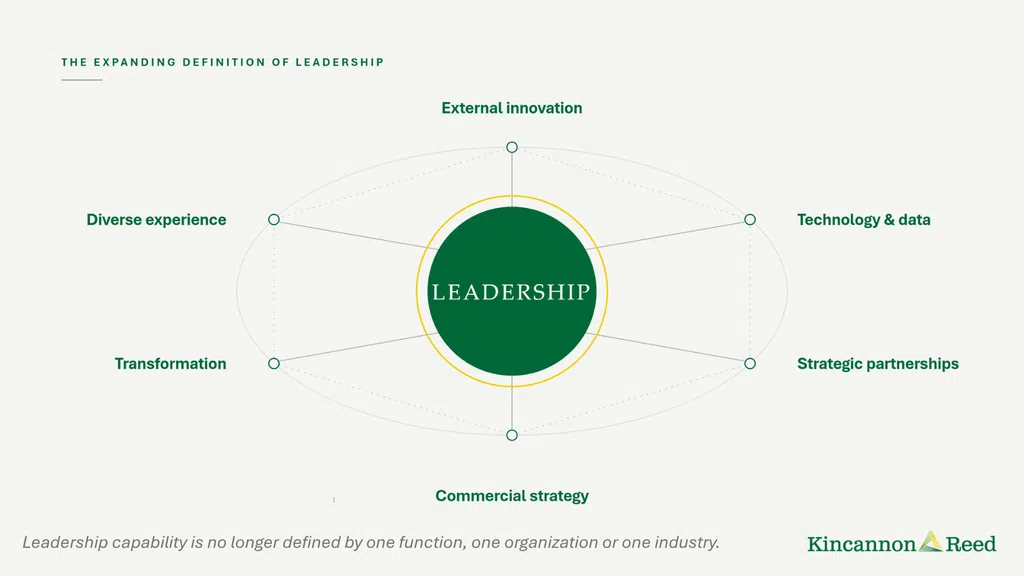
Across animal health, investment and innovation are taking many forms, with data, analytics and connected technologies creating new opportunities in both companion animal and livestock health. The adoption of these technologies appears to be gaining particular momentum in livestock, where applications such as video recognition and grazing management are being used to address productivity and operational challenges.
For leaders, this means understanding innovation beyond traditional therapeutic development.
Technology and data are becoming increasingly important to productivity and value creation, but the ability to identify a technology is only part of the challenge. Leaders also need to understand how it can be integrated into the business, adopted by customers and ultimately translated into sustainable value.
This creates another demand for leadership breadth: executives must increasingly be comfortable operating at the intersection of science, technology, commercial strategy and external partnerships.
Another shift may be even more consequential for established organizations: the traditional assumptions around the durability of animal health brands and products are changing.
Historically, generic competition could take time to materially erode a successful animal health product. More recent examples suggest that the period of protection following loss of exclusivity can be considerably shorter.
At the same time, successful therapeutic categories are becoming larger and more attractive. That creates a paradox: commercial success attracts investment and innovation, but it can also create a much larger target for competitors and generics.
For senior leaders, this raises the stakes around anticipation and transformation.
Organizations can no longer assume that past performance or established market position will provide a long runway for the next stage of growth. Leaders need to recognize when an existing business model is approaching a structural change and have the willingness — and organizational capability — to respond before circumstances force the issue.
Perhaps the most important implication is the growing value of diversity of experience.
Animal health has matured to the point where deep industry knowledge remains important, but industry tenure alone may not provide all the perspectives required for the next phase of growth. Organizations are confronting challenges that other industries have already experienced: rapid innovation cycles, changing sources of value, disruptive technologies, intensified competition and pressure to transform established business models.
That creates a compelling case for looking beyond traditional talent pools.
A leader who has navigated similar challenges in another sector may bring a valuable perspective precisely because they are not constrained by the assumptions that have historically shaped animal health. They may have developed the same underlying leadership capabilities — transformation, commercial strategy, operational discipline, innovation or financial management — in a very different environment.
That outside perspective can challenge organizational habits and create new possibilities.
The common thread across these trends is not simply that the industry is changing. It is that the definition of leadership capability is changing with it.
Future-focused organizations will need leaders who can operate across boundaries: between internal and external innovation, established companies and startups, science and technology, industry expertise and outside perspective, growth and transformation.
That may require a broader approach to executive recruitment and succession planning. Rather than asking only, “Who has done this job before?” organizations may need to ask, “Who has developed the capabilities required for what comes next?”
In a rapidly evolving animal health landscape, experience still matters. But breadth of experience, adaptability and the ability to see beyond traditional industry boundaries may matter just as much.
The organizations that recognize that shift, and build leadership teams accordingly, will be better positioned to navigate what comes next.
For organizations navigating these changes, we’d welcome a conversation to discuss your leadership needs.
Kincannon & Reed incorporates validated interview techniques and evaluation tools to accurately assess candidates. We have the capability to measure personality traits, motivations and evaluate specific competencies and behaviors. The right assessments provide a balanced approach to understanding potential as much as experience.
Coaching empowers executives to reach their full potential faster, benefiting your organization. We partner certified coaches with executives and use a strengths-based approach to guide leaders through a process that maximizes their potential to drive success.
We bring a history of success delivering advisory and fiduciary board members specifically for family, start-up, and growth organizations. Our industry networks and broad access to executive leadership bring willing candidates from every corner of the market to serve on your board.