Reflections from the 2026 CPDA Annual Meeting
By Aaron Locker, Managing Director, Kincannon & Reed
The 2026 CLA/CPDA/TFI Annual Meeting brought together a broader cross-section of the agriculture industry than in years past. With the Council of Producers & Distributors of Agrotechnology (CPDA) co-located alongside CropLife America and The Fertilizer Institute, the event brought leaders from across crop protection, adjuvants, ingredients and fertilizer into the same conversation. More than 900 agriculture industry leaders attended the three-day meeting in Dallas.
For me, one of the most valuable parts of that broader audience was the opportunity to hear how different segments of the industry are thinking about the same fundamental questions: Where is the market headed? What will growth require? And perhaps most importantly, what kind of leadership will organizations need to get there?
The overall mood was cautiously optimistic.
There is a sense that the industry may have reached the bottom of the current cycle. Commodity prices have begun moving in the right direction, even if the recovery is not dramatic, and companies are starting to think beyond simply managing through uncertainty.
That shift matters from a talent perspective.
After a period when many organizations were understandably hesitant to make significant leadership moves, conversations are beginning to change from “Let’s talk again next quarter” to “We know we’re going to need to do something.” That’s a healthy change, because waiting too long on leadership decisions tends to narrow an organization’s options.
And those conversations are revealing some important leadership challenges.
I left Dallas with a long list of follow-up conversations across the crop inputs sector. Some of those needs are being driven by retirement. Others are the result of businesses changing and requiring different capabilities to pursue their next stage of growth.
That distinction is important.
Organizations aren’t simply replacing the person who held a role previously. In many cases, they are asking whether the role itself needs to look different.
The skills that helped an organization navigate the last three to five years may not be the same skills required to lead through the next three to five. Experience remains valuable, but it may not be enough on its own when the business needs new capabilities or a different perspective.
I’m not hearing companies say they need an AI expert in every leadership role. What they are looking for is something more practical: leaders who understand technology well enough to connect it to the business.
How can technology make the organization more efficient? How can it improve customer service? Where can data or AI-enabled tools improve decision-making? And where does technology create real value rather than simply add another layer of complexity?
Those are leadership questions, not technology questions.
The strongest leaders will be the ones who can connect emerging capabilities to the organization’s broader strategy. We recently explored what AI fluency looks like for food and agriculture executives, and it has far more to do with judgment than with tools.
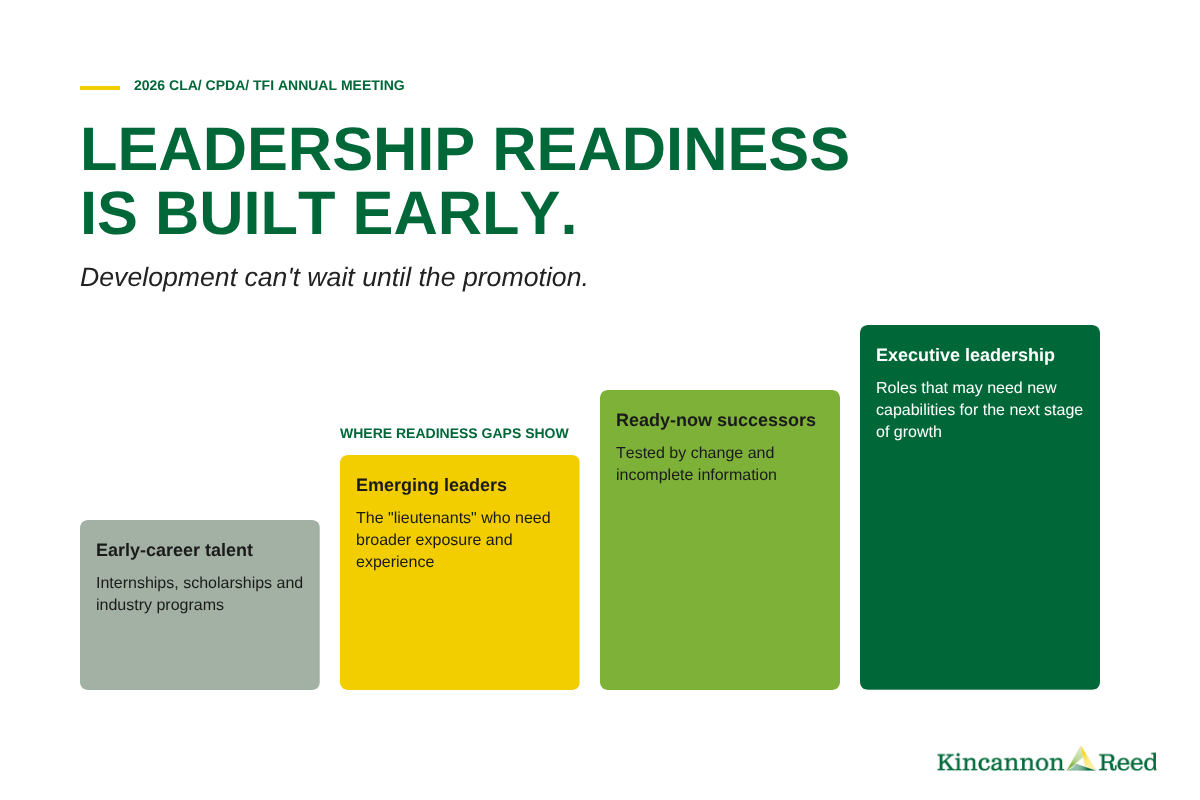
One of the most consistent themes I heard at the meeting was less about finding the next CEO and more about preparing the people who will eventually become one.
Several conversations came back to what one person described as their “lieutenants”—the middle tier of leaders who are expected to step into larger roles but aren’t quite ready yet.
That is becoming a significant challenge.
Agriculture is dealing with an aging workforce, fewer people entering the industry and a talent market where experienced professionals are often less willing or able to relocate for the next opportunity. At the same time, there hasn’t always been the same level of movement between organizations and roles that historically helped people broaden their experience.
The result is a leadership pipeline that can look healthy on paper but is thinner than it appears when you look closely at readiness. In some cases, organizations will need to develop internal candidates; in others, bringing in an outside leader can introduce the skills, experience or fresh perspective needed to navigate a changing business climate.
There are capable people in the organization.
The question is whether they have been given the experiences, exposure and development needed to lead at the next level.
I think some of this challenge is self-inflicted.
For a period of time, organizations across the industry placed less emphasis on development. When business conditions are difficult, it is understandable that development can fall down the priority list. The immediate needs of the business take precedence.
But eventually, those decisions catch up with you.
If you wait until someone is considered for a significant leadership role to start developing them, you’ve probably waited too long.
Leadership readiness is built through experience. It comes from taking on unfamiliar responsibilities, working across functions, making decisions with incomplete information, leading through change and learning how to influence people beyond your immediate area of expertise.
That means development needs to happen well before the succession conversation becomes urgent.
For organizations facing a wave of retirements and changing business requirements, that may mean taking a harder look at the leadership pipeline they have today and being honest about where the gaps really are.
There is another side to this challenge that will take longer to solve.
Companies across agriculture continue to invest in internships and other programs designed to attract early-career talent. Industry organizations are also creating opportunities for students and young professionals to build relationships with potential employers.
I’ve seen this firsthand through the Mid America CropLife Association’s (MACA) Young Leader Scholarship Program, which combines financial support with opportunities for participants to engage directly with industry leaders and potential employers.
Those efforts matter.
We won’t solve today’s executive leadership gap by recruiting more entry-level employees, but we also won’t solve tomorrow’s gap without them.
Agriculture has an opportunity to do a better job telling its story to people who may not have considered the industry. The technology, science, innovation and strategic complexity behind modern agriculture look very different from the outdated perception many people still have of the industry.
Creating that interest, and then giving emerging talent meaningful opportunities to learn and grow, has to be part of the longer-term talent strategy.
Succession planning came up repeatedly in conversations at the meeting, and I think that is where several of these issues ultimately converge.
Organizations know they have experienced leaders approaching retirement. They know some roles will change as the business changes. They know technology is creating new expectations. And they know the next generation of leaders may not have the same experience or career paths as the generation before them.
The answer isn’t simply to identify who could replace whom.
It’s to ask whether the organization is building the leadership capacity it will need in the future, something we highlighted in our Mid-Year Talent Trends report.
That means identifying high-potential leaders earlier, giving them opportunities to broaden their experience and developing the skills they don’t yet have and being willing to recognize when the person best positioned to lead the organization forward may not look exactly like the person who led it in the past—or may come from outside the organization.
The conversations I had in Dallas reinforced something I’ve been seeing in executive search for some time: the leadership challenge ahead isn’t simply about finding talent. It’s about preparing talent for what the business will require next.
The industry may be moving into a period of greater stability. If that’s the case, organizations have an opportunity to use that stability wisely, not just to fill the roles that are open today, but to build the leadership capacity that will allow them to pursue growth tomorrow.
Because when the market starts moving again, the organizations that are ready won’t just have a strategy for where they want to go. They’ll have the leaders ready to take them there.
***
For organizations thinking through their leadership needs, succession plans or the capabilities required for their next stage of growth, I’d welcome a conversation. These discussions are often most valuable when they begin well before a transition becomes urgent.